Industry and nature in symbiosis isn’t how a working saltworks usually gets described — but that’s exactly what these sites are. They produce salt at commercial scale, and at the same time support some of the richest wetland ecosystems on Europe’s coastline. The two aren’t a coincidence sitting side by side: one depends on the other.
A Food Chain That Starts With Colour
It starts somewhere unexpected: with the colour of the water itself. As seawater concentrates through a saltworks’ evaporation ponds, extremophile microorganisms — halophilic bacteria, archaea and algae adapted to survive in near-saturated brine — begin to thrive. Many of them produce carotenoid pigments, the same family of pigments behind autumn leaves, which tint the ponds shades of pink and red.
That colour isn’t just scenery. The darker water absorbs more heat, raising its temperature and speeding up evaporation — meaning these microorganisms are quietly helping the salt production process along. They’re also the base of a food chain: they’re grazed on by Artemia salina, a tiny brine shrimp that thrives in conditions almost nothing else can survive. Artemia, in turn, is a key food source for the birds a saltworks becomes known for — flamingos above all, but also gulls, herons and other wading birds.
From Flamingos to a Plant Found Nowhere Else
The clearest example of this sits at Bras del Port‘s saltworks in Santa Pola, Alicante — part of a natural park spanning roughly 2,500 hectares. Flamingos are the park’s best-known residents, with breeding-season numbers reaching around 8,000 birds, alongside avocets, plovers, herons, gulls and several species of duck. Along the water’s edge grow reed beds, salt-tolerant salicornia, and Limonium santapolense — a sea lavender found nowhere else on Earth except this stretch of coastline.
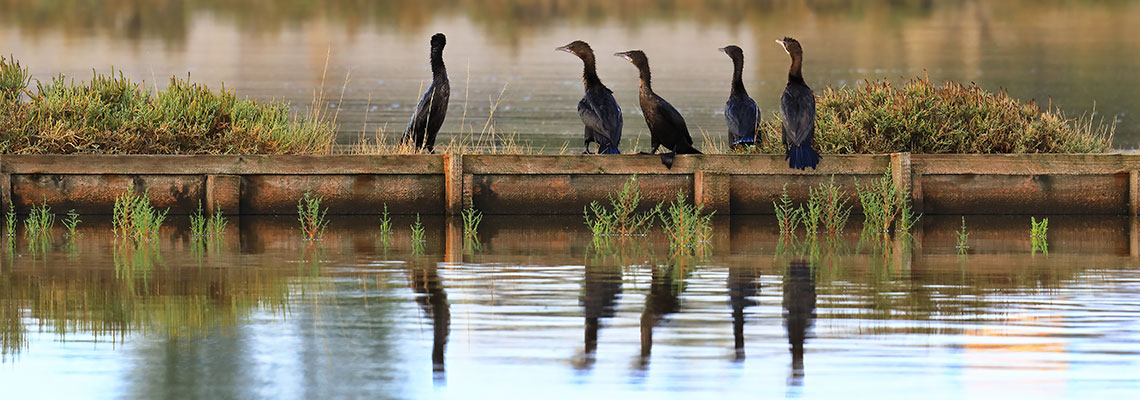
The same pattern repeats at sea saltworks across Europe. At the Ebro Delta in Catalonia — a Ramsar-listed wetland spanning over 7,700 hectares where member INFOSA operates — more than 300 bird species have been recorded. In Croatia, the salt pans at Nin, worked by member Solana Nin, host over 150 bird species on their own, 41 of them in threatened categories, including the endangered Kentish plover, plus the endangered Mediterranean toothcarp fish and the same brine shrimp found at saltworks everywhere. At member Salinas del Odiel‘s saltworks in Huelva, a ringing station has recorded more than 25,000 birds across 43 species since 1997. Greece’s Hellenic Saltworks operates eight sites recognised under the EU’s Natura 2000 network as vital habitat for local wildlife. Different countries, different species lists — the same underlying pattern of a working saltworks doubling as a wildlife stronghold.
Why the Wetland Needs the Saltworks, Not Just the Other Way Around
This is the part that’s easy to miss: many of these wetlands aren’t untouched nature that industry happens to have left alone. In Croatia, salt has been harvested at Nin for more than a thousand years, and the wetland’s character today owes as much to that continuous human activity as it does to nature on its own. At Portugal’s Ria Formosa — an 18,400-hectare natural park and Ramsar wetland where member Necton produces salt — the company describes its own salt pans as part of an ecosystem that also includes microalgae, halophytes and a rich bird life, flamingos included. In both places, the salt-making doesn’t happen despite the wetland — it’s a large part of what keeps the wetland the way it is.
It’s well understood among those who manage sites like these: if the salt-making stopped, that balance would break down, and the wetland would dry into cracked, lifeless ground within a matter of years. The industry isn’t a threat these ecosystems merely tolerate — for many of them, it’s the reason they exist at all.
A Landscape Worth Protecting
It’s this two-way relationship that has earned so many sea saltworks formal protection. Across SEASALT Europe’s membership, saltworks sit inside sites recognised under the Ramsar Convention on Wetlands, the EU’s Natura 2000 network, or as UNESCO Biosphere Reserves — a level of recognition that reflects just how much wildlife depends on a landscape most people assume is purely industrial.
Explore more
Curious about the wetlands behind Europe’s sea saltworks? Visit our Members directory to see individual profiles.


