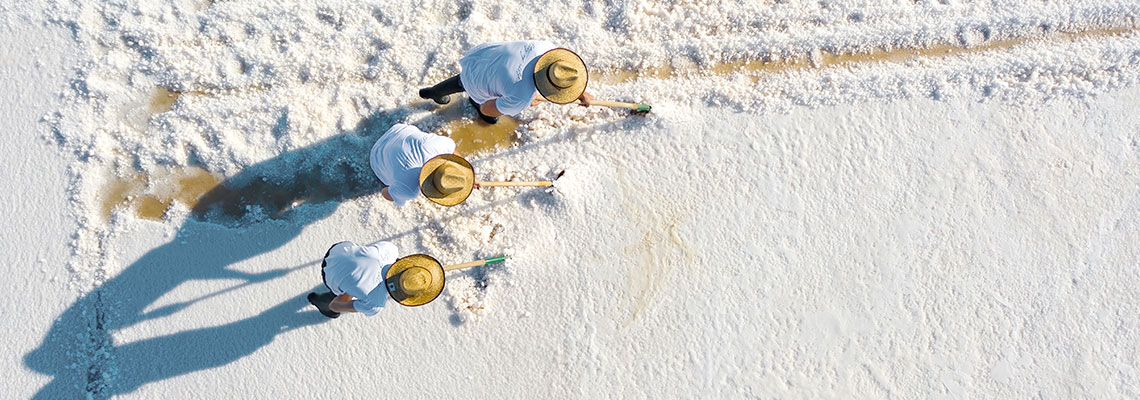
Across Europe, the sea salt harvest doesn’t follow a single calendar. At some sea saltworks it starts as early as May; at others, it doesn’t begin until August and can run into October. The exact window depends on climate, water salinity, and the rhythm each site’s sea salt farmers have refined over generations. What happens once the ponds are ready varies just as much: some sea saltworks still gather salt entirely by hand, others combine hand work with machinery, and others rely on equipment built to move tonnes in a single pass. All three approaches are alive and working across our members’ sea saltworks today.
When does the harvest happen?
There’s no single harvest date for European sea salt — and that’s by design, not by accident. Salt only crystallises once seawater has evaporated enough to reach the right concentration, so the window depends on sun, wind and humidity as much as the calendar. At the Xwejni Salt Pans in Gozo, Malta, the pans are filled and harvested weekly through a short window from mid-May to early September, with each cycle taking about seven days of evaporation — hot, sunny days keep it on schedule, while a stretch of rain or storms disrupts it. Elsewhere around the Mediterranean, many sea saltworks harvest later, with the season peaking between August and October instead. Either way, the sea salt farmers are watching the same thing: sun, wind, and the water.
Manual harvest: the fully traditional method
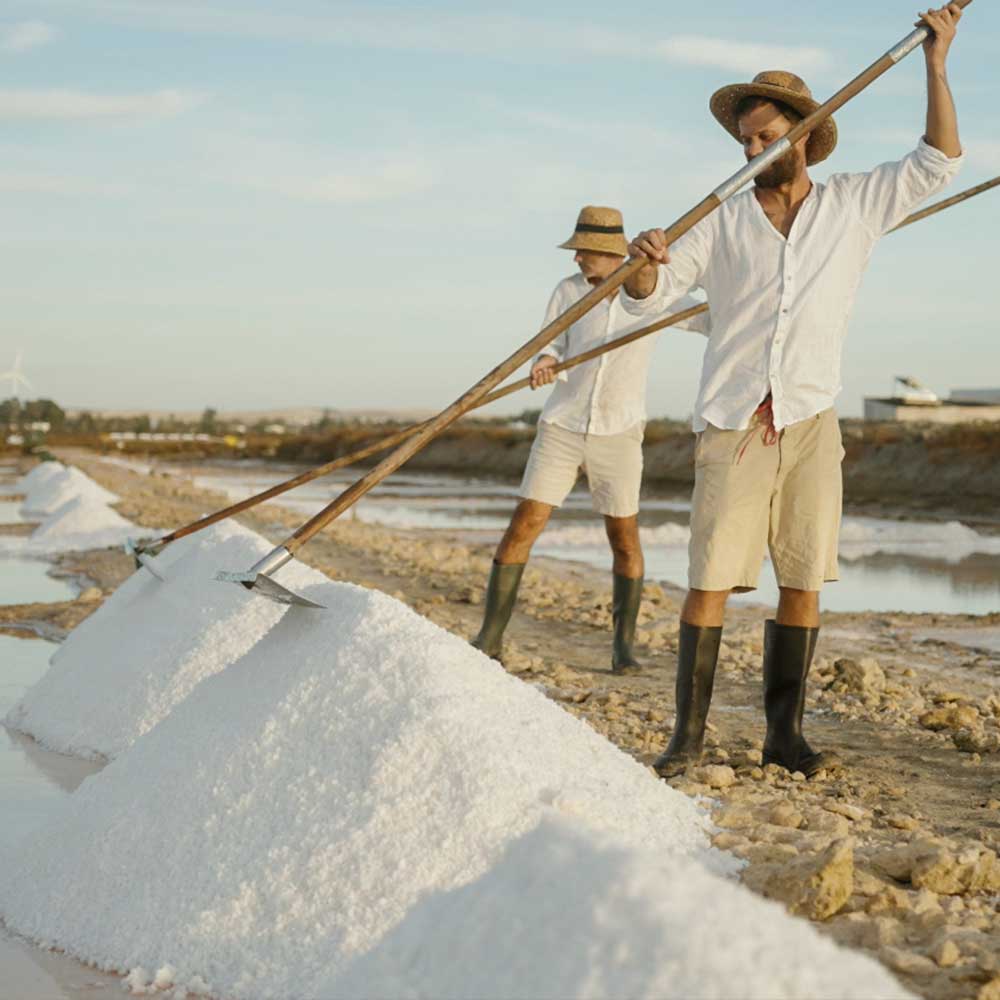
In some sea saltworks, harvesting is still done entirely by hand, exactly as it has been for generations. At Salinas de Cádiz, sea salt farmers extract what they call “virgin sea salt” by hand, respecting the natural aging process of each crystal. In the Bay of Cádiz, this tradition has its own vocabulary: the wooden rake traditionally used to gather the salt is known locally as the palín, and the hand cart used to move it is the carrillo de mano.
On the other side of Europe, at the Xwejni Salt Pans in Gozo (Malta), the method looks different again: the shallow pans are filled individually using a motor pump, and once the water evaporates, the crystals are gathered not with a rake but by sweeping and brushing — using brooms and thick-bristled brushes — into heaps, then moved onto drying surfaces and packed into 30kg bags without further processing.
Manual harvest is also how Salinas de Tenefé works in Gran Canaria. It’s slower and produces far lower volumes than mechanized harvest, but that slowness is exactly what preserves each crystal’s natural shape and mineral character.
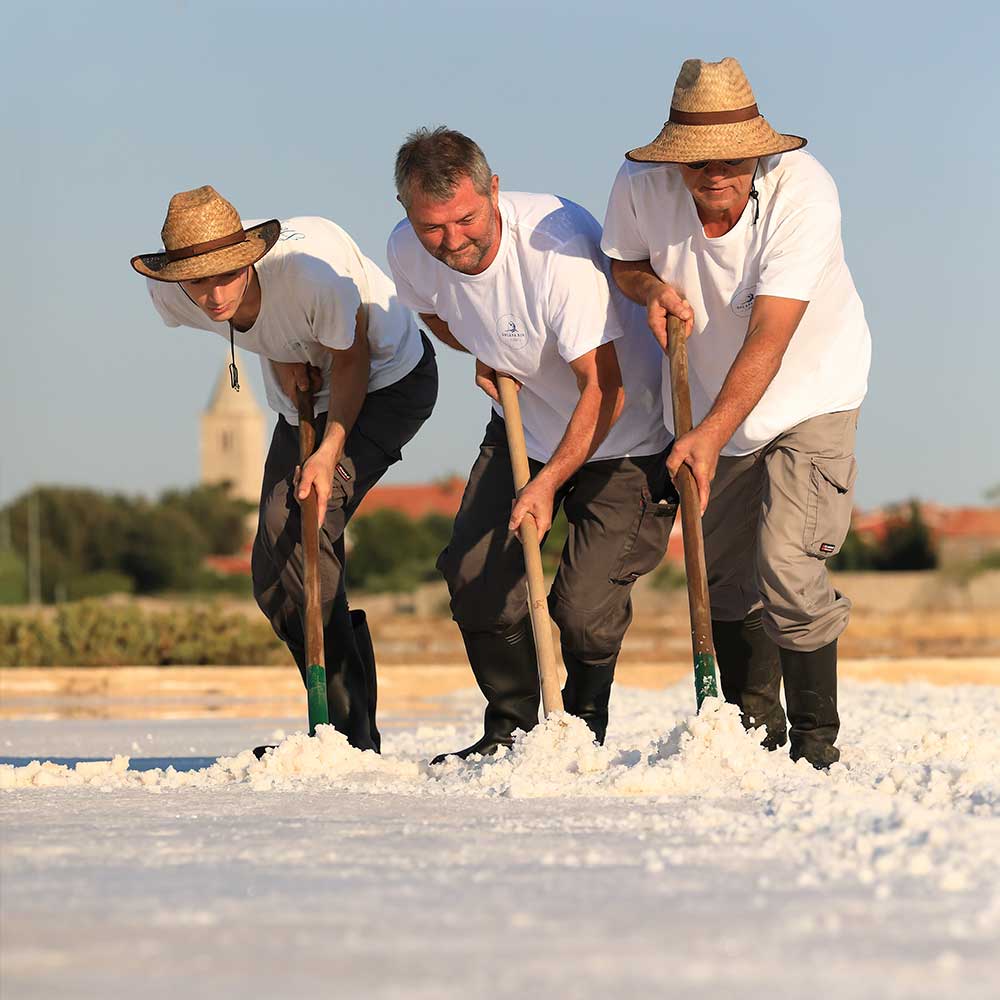
Further east, on Croatia’s Adriatic coast, Solana Pag (Pag Island) and Solana Nin (Nin) keep the harvest manual too, each drawing on more than a thousand years of local saltmaking tradition. At Solana Nin, workers skim the delicate salt flower off the surface with a fine sieve on calm, sunny mornings, then drain the ponds and gather the coarser crystals underneath by hand.
Where hand work and machinery meet
Some of our members run both methods side by side. At Salinas d’Es Trenc (Mallorca), INFOSA‘s saltworks in the Ebro Delta (Tarragona), and Salinera Española‘s saltworks in San Pedro del Pinatar (Murcia), bulk salt is harvested mechanically, while a separate, much smaller batch is still gathered entirely by hand: flor de sal.
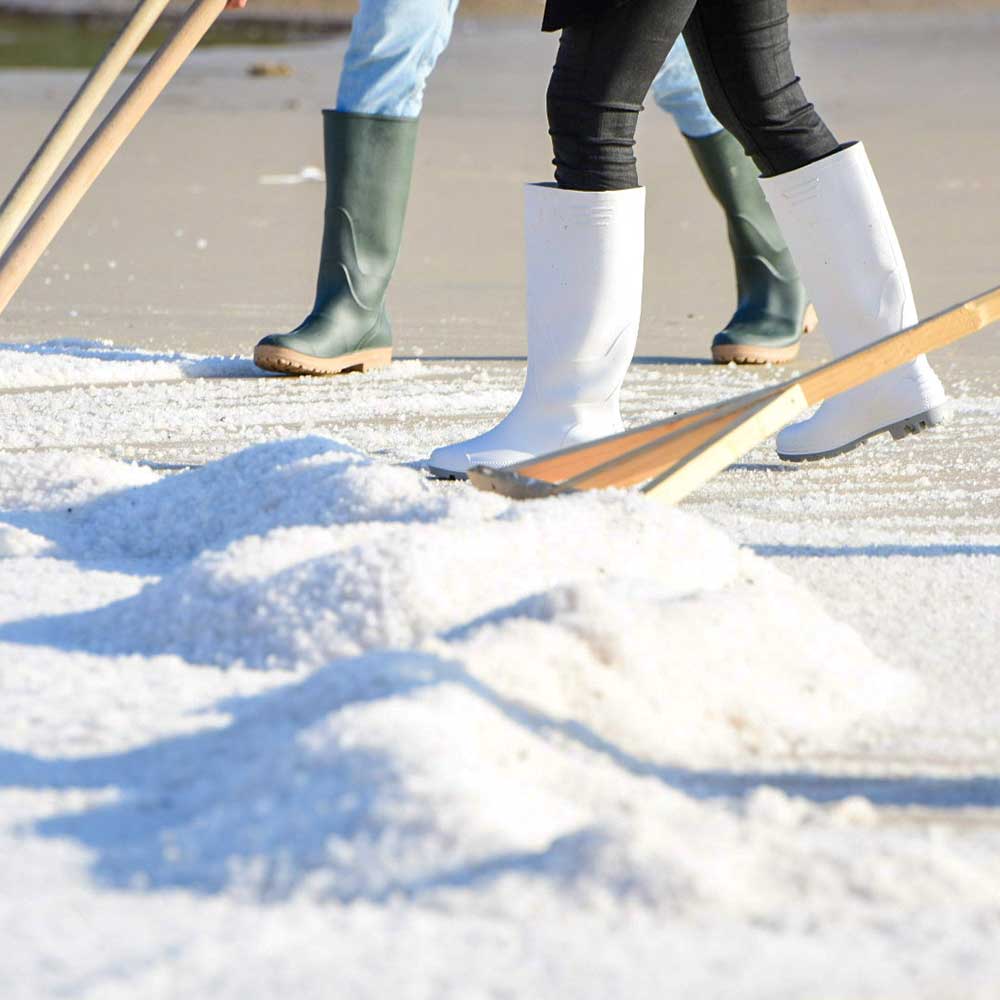
Flor de sal (fleur de sel) is the most delicate product any of these sites produce. Under the right conditions — sun, a light breeze, still water — a thin film of fine, fragile crystals forms on the surface of the pond before it has time to sink. At Es Trenc, sea salt farmers comb the surface of the water, just a couple of millimetres deep, with a small rake to gather these crystals — usually in the early morning, on the one or two days a week the conditions actually allow it. It’s a small, weather-dependent harvest, which is part of why flor de sal commands a premium over the bulk salt taken from the same ponds.
Mechanized harvest: the industrial method
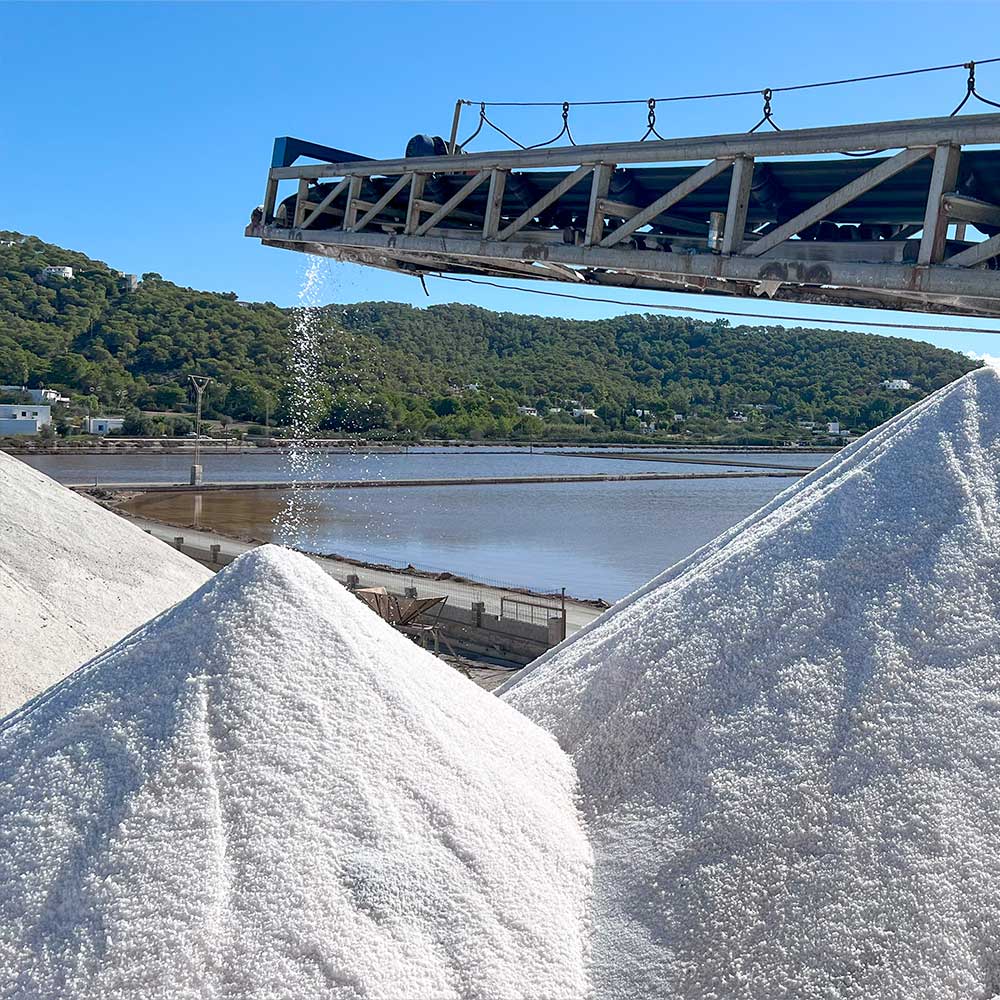
Higher-volume producers rely on machinery purpose-built for the job. Self-propelled harvesters move across the crystallisation ponds fitted with large blades or scrapers that lift the settled salt from the pond floor and load it directly onto a conveyor or into an onboard hopper — gathering, in a single continuous pass, what a hand-raking crew would take far longer to collect. From there, loaders pile the raw salt into large mounds to drain before it’s trucked to washing, grading and, where relevant, iodizing and packaging facilities.
This is how our members Bras del Port (Alicante), ASAL Group (Marítima de Sales, with saltworks in Cádiz), Salinas del Odiel (Huelva), and Salinera Española’s saltworks in Ibiza bring in the bulk of their production. The method trades some of the crystal’s natural irregularity for speed and volume — which is exactly what lets these sea saltworks supply the tonnage that food processing, water treatment, de-icing and other bulk uses require.
Beyond Europe: our international members harvest too
SEASALT Europe’s membership doesn’t stop at Europe’s coastline. Among our collaborating members, ESSA (Exportadora de Sal) runs one of the largest saltworks in the world in Guerrero Negro, Mexico — a fully mechanized operation moving salt at a scale few sites anywhere can match. It’s a reminder that the questions of scale, tradition and method covered here reach well beyond our members’ European sea saltworks.
Why every method matters
Manual, mixed and mechanized harvest aren’t a hierarchy of “traditional equals better.” They serve different markets and different needs. Hand-raked salt — and flor de sal above all — supplies gourmet and specialty markets that value texture, appearance and the story behind the product. Mechanized harvest supplies the volume the wider sector needs to stay economically viable, including, in many cases, the smaller hand-harvest lines running alongside it on the very same site.
SEASALT Europe represents sea salt farmers across this entire spectrum — from single-site operations still sweeping ponds by hand to industrial-scale sea saltworks moving thousands of tonnes a season. It’s that range, working together, that keeps sea salt production a living, working part of Europe’s coastline.
Explore more
Curious which of our members harvest by hand, by machine, or both? Visit our Members directory to see individual profiles — and look out for more harvest-season coverage from across Europe’s sea saltworks in the coming weeks.