
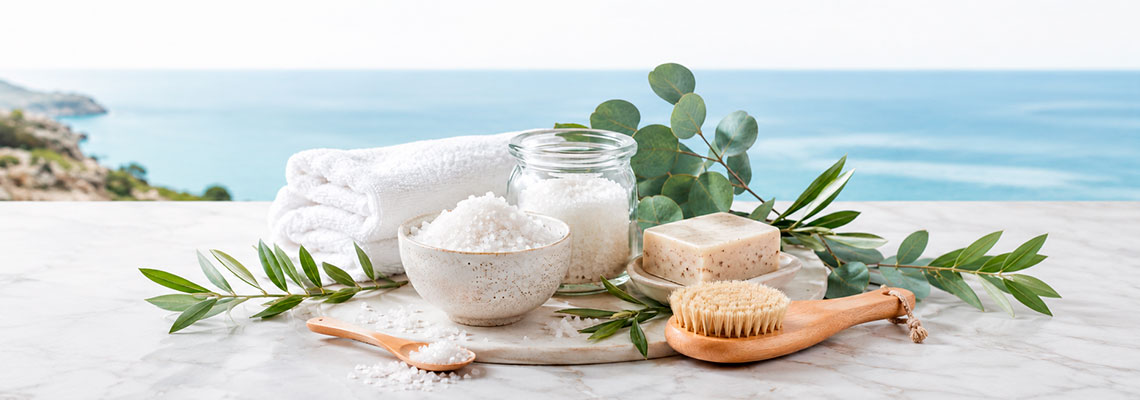
Sea salt for beauty and relaxation isn’t a new idea. Coastal communities have leaned on seawater and salt for centuries, long before “self-care” was a word anyone used. From mineral baths in 19th-century France to a spoonful of coarse salt rubbed into damp skin in a modern bathroom, the connection between salt and how people look after their skin, hair and stress levels has never really gone away.
A Rough Texture With a Simple Job
The most straightforward use is also the oldest: exfoliation. Coarse sea salt crystals, mixed with a carrier oil such as olive, almond or coconut oil, work as a simple mechanical scrub — the rough grains slough off dead skin cells as they’re massaged over damp skin, leaving it smoother. It’s a purely physical action, not a chemical one, which is part of why the recipe hasn’t changed much in generations: salt, oil, and a bit of friction.
Grain size matters here. Fine salt dissolves too quickly to scrub effectively, while a coarser grind holds its texture through the massage — which is why several sea saltworks across Europe sell both fine table salt and a coarser grade side by side, letting the coarser one double as a bathroom staple as much as a kitchen one.
The Bath Ritual Behind Thalassotherapy
Dissolving sea salt into a warm bath is a smaller-scale version of thalassotherapy — from the Greek thalassa, “sea” — a tradition of using seawater and marine climate for wellbeing that goes back to Roman times. It became a formal practice in 19th-century France, where the first dedicated centre opened in Boulogne-sur-Mer in 1800, followed by Dieppe’s seawater spa in 1822. The modern version took shape in 1964, when the cyclist Louison Bobet founded the Quiberon institute that’s still considered the model for thalassotherapy centres today.
A home bath obviously can’t replicate a thalassotherapy centre’s heated seawater treatments — and it’s worth being direct about what a sea salt bath does and doesn’t do. It doesn’t “detox” the body or draw out toxins through the skin by osmosis, whatever wellness articles might claim; there’s no solid evidence behind that idea. What it does offer is simpler and still worthwhile: warm water for muscle relaxation, and a mineral-rich, faintly textured soak that many people find genuinely calming as a ritual.
The Salt-Stomping Trend, Explained
Salt even had a viral moment this year (2026): “salt stomping,” standing barefoot on a bed of coarse salt for a few minutes before bed, spread widely on social media as a relaxation trick. It’s tempting to describe it as a kind of acupressure, but that’s not quite right — doctors interviewed about the trend were clear that there’s no evidence it changes stress hormones, or that minerals absorb through dry skin contact. What actually seems to help is simpler: the uneven, textured surface pulls your attention into your feet and out of a racing mind, the same grounding effect behind a lot of mindfulness practices. It’s a real ritual with a real, if modest, calming effect — just not the physiological one it’s often sold as.
What Sea Salt Does to Hair
Sea salt spray is a genuine cosmetic staple, not a myth: salt is hygroscopic, meaning it draws moisture toward itself, and when dissolved in a light spray it pulls some moisture out of each strand of hair as it dries. That subtly roughens the hair’s outer cuticle, which is what creates the tousled, “beachy” texture and extra volume without any oils or styling polymers involved.
The trade-off is the same dehydrating effect that makes it work: overuse can leave hair dry, especially if it’s already fine, colour-treated or prone to frizz. Used sparingly, and balanced with a leave-in conditioner, it’s a low-effort way to add texture — which is probably why it has stayed a bathroom-cabinet regular for so long.
Where to Find Sea Salt for Beauty and Relaxation
Curious about the different grades of sea salt behind these everyday rituals — fine, coarse and everything in between? Visit our Members directory to see what each saltworks produces.