
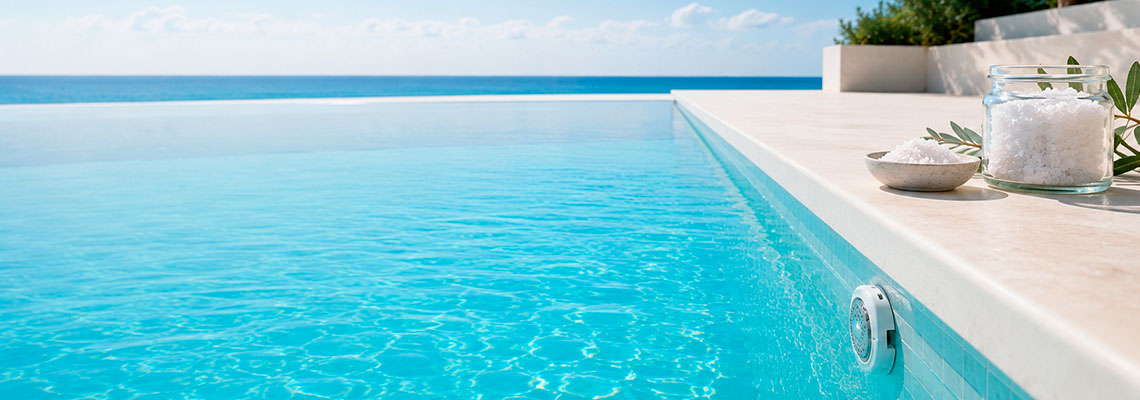
Saltwater pool chlorination doesn’t skip chlorine — it generates it on-site, through sea salt electrolysis, from salt already dissolved in the water. If you’ve ever swum in a pool run this way, you’ve probably noticed the difference right away: the water feels softer, your eyes don’t sting, and there’s none of that sharp chlorine smell you brace for at a traditionally chlorinated pool. Here’s what sea salt electrolysis actually does, and why so many pool owners are switching to it.
How does sea salt electrolysis actually work?
A saltwater pool starts with a small amount of salt dissolved into the water, typically between 1.5 and 5 grams per litre, far less than seawater. That water passes through a salt chlorinator: a device fitted with an electrolytic cell that runs a low electric current through it. The current splits the dissolved salt (sodium chloride, NaCl) apart, and the chlorine released reacts instantly with the water to form hypochlorous acid (HOCl) — the exact same active disinfectant used in a traditionally chlorinated pool.
Once the hypochlorous acid has done its job — killing bacteria and algae — it naturally converts back into salt. It’s a closed loop: the same salt gets reused to generate chlorine, over and over, with only minimal loss over time (mostly from backwashing the filter, topping up water, or rain diluting the pool). That’s why you only need to add more salt occasionally, not daily.
The advantages: gentler on skin, hair and eyes
This is usually the first thing people notice. Because chlorine is produced in small, continuous amounts rather than added in a concentrated dose, saltwater pools don’t carry the sharp smell associated with traditional chlorine. The water is also noticeably softer, and swimmers commonly report less irritation to the eyes, skin and hair — a real difference for families with young children or anyone with sensitive skin.
The advantages: steadier, more consistent disinfection
Manually dosed pools rely on someone adding chlorine at the right time, in the right amount — too little and algae gets a foothold, too much and you’re back to stinging eyes. A salt chlorinator produces chlorine continuously and automatically, with built-in regulation that adjusts output to keep levels steady. The result is more consistent water quality with far less day-to-day guesswork.
The advantages: less handling of chemicals
Because the chlorinator generates chlorine on demand from the salt already in the water, there’s no need to store, measure or handle concentrated chlorine products directly. The process also tends to keep the water’s pH more stable, which in turn reduces how often you need to add pH-correcting acid. Less manual handling means less risk — and less hassle.
Sea salt and saltwater pool chlorination: a natural fit
Not just any salt works well in a chlorinator. Table salt and de-icing salt, for example, often contain anti-caking agents that can interfere with the electrolytic cell or leave residue in the pool. Europe actually has its own standard for this — EN 16401, which sets purity requirements and rules out those additives specifically for electrochlorinator salt, and sea salt routinely meets it as it is, without anything added or taken away.
We recommend sea salt for saltwater pool chlorination — and not only because it performs well. Sea salt is produced by nature itself: sun and wind slowly evaporate seawater in shallow ponds, with no industrial processing needed to reach the purity that standard requires. Those same ponds, the salinas, double as wetland habitats that support rich biodiversity, from migratory birds to salt-tolerant plants found almost nowhere else. And behind many of them is still a small, traditional way of working — choosing sea salt also helps keep that centuries-old craft alive.
Is a saltwater pool right for you?
If you’re weighing up the switch, the trade-off is mostly upfront: a salt chlorinator costs more to install than a standard setup, and it needs the right type of salt to perform properly. But day to day, most owners find it easier to live with — steadier water quality, less handling of chemicals, and a noticeably gentler swim.
Explore more
Curious about the sea salt behind everyday products like these — not just in your pool, but in your kitchen too? Visit our Members directory to see the producers behind it.