
PRESS RELEASE
European institutional consensus shields organic sea salt from attempts to exclude it in the reform of the EU Organic Regulation
- Broad institutional front: Neither the European Commission, nor the Council of the European Union, nor the European Parliament’s Committee on Agriculture (AGRI) proposed removing salt from Regulation (EU) 2018/848.
- Restrictive amendments fall away: Amendments 150 and 151 were never voted on individually, as they were absorbed into the compromise agreement (Compromise 3), lapsing and being replaced in the opinion approved by 37 votes in favour.
- Legal certainty and impact: Excluding salt would have threatened the investments of more than 250 European operators registered on the TRACES platform and the environmental value of southern Europe’s marine salt pans.
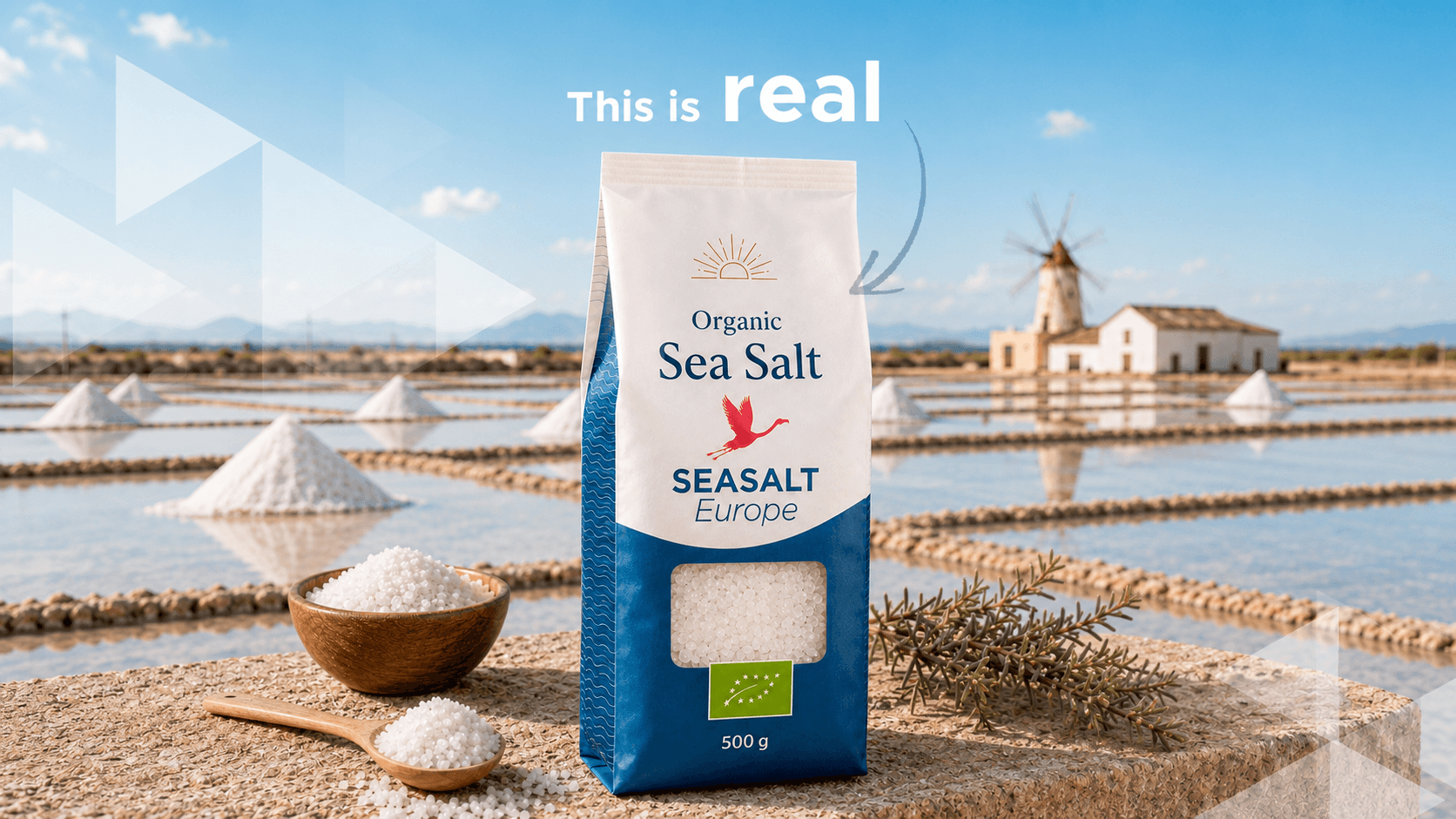
SEASALT Europe, the association representing European sea salt producers, wishes to state that, following the recent approval by the European Parliament’s Committee on Agriculture and Rural Development (AGRI) of the update to the Organic Production Regulation, the European Union’s institutional framework reaffirms that organic sea salt retains its status and legal protection intact in the EU market.
The original amendment proposal put forward by the European Commission was strictly built around three objectives of urgent necessity: adapting the rule to the case law of the Court of Justice of the EU on the use of the Euroleaf on equivalent products from third countries, urgently extending international equivalence recognitions before their expiry at the end of 2026, and introducing technical simplification measures with broad sectoral consensus.
In this context, the rapporteur for the report, MEP Camilla Laureti, highlighted the spirit of the reform:
«My goal is to provide the sector with a stable regulatory framework that simplifies certain rules where possible, without overturning them after just a few years of implementation. It is a framework that maintains the quality and therefore the reputation of the sector, in Europe and globally, while respecting consumers».
Clarifying the procedure: Amendments 150 and 151
During the parliamentary process, isolated amendments (150 and 151) were tabled seeking to exclude salt from the scope of the Regulation. However, these proposals were never put to an individual vote, as they automatically lapsed when absorbed into the text agreed under Compromise 3 on annexes and production rules.
Once this consensus package was approved, Amendments 150 and 151 were formally replaced and excluded from the final opinion. The AGRI Committee gave the green light to the overall opinion by 37 votes in favour, 4 against and 8 abstentions, also granting the mandate to open final negotiations (trilogues) with 40 votes in favour, 8 against and 1 abstention.
Technical rigour against the arguments made against organic salt
The attempt to challenge the status of salt lacked both representativeness and regulatory grounding within the file:
- Lack of sectoral representativeness: Of the 228 amendments tabled to the draft report, only 2 (a marginal 0.88%) mentioned salt, showing that this was a debate unrelated to the main purpose of the reform.
- Geographic bias and impact on Southern Europe: The restrictive amendments, put forward by MEPs from countries without sea salt production, sought to veto a certification that protects the ecological value and biodiversity of the marine salt pans of the Mediterranean and Atlantic basins.
- Compatibility with public health (iodine): Arguing incompatibility with iodisation is false. Regulation (EU) 2018/848 explicitly permits the addition of minerals where required by national legislation. Organic salt can be iodised and legally carry the European logo, as confirmed by Commissioner Christophe Hansen on 19 January 2026 in a parliamentary answer.
- Nature of the product: The inclusion of salt is already grounded in Recital 10 of Regulation (EU) 2018/848, which rewards natural and sustainable extraction processes and their contribution to rural development, assessing the overall sustainability of the process rather than mere chemical composition.
Unwavering institutional and economic backing
Excluding salt would have caused direct harm to the more than 250 EU operators currently marketing certified organic salt under the official TRACES platform, undermining the legal certainty of investments made since 2018 and leaving consumers unprotected.
Both the European Commission — which in its working document ruled out excluding salt after finding that only 2.7% of public consultation comments mentioned it — and the Council of the European Union — which in its negotiating mandate of May 2026 proposed no change whatsoever — support keeping sea salt within organic production (status quo).
Next steps
Following approval in the parliamentary committee, the text will move to a vote in the European Parliament’s plenary session, paving the way for the final talks between Parliament, the Commission and the Council. All indications are that the final agreement, expected before the end of 2026, will keep organic sea salt fully protected and supported.
More information: www.seasalteurope.com
📄 Download the full press release (PDF)
Press contact: communication@seasalteurope.com